
Crucible Ladder: Transfers-As-Propulsion (TAP)
The Crucible Ladder is a distributed chain of Caudex Stations, each equipped with an electromagnetic channel capable of capturing and launching transfers‑as‑propulsion. In this configuration, each station functions as a Crucible Ladder Rung. Transfers are ferrous capsules carrying materials, cargo, or crew, that are exchanged between rungs to provide propulsion through momentum exchange.
Crucible Ladder Earth-Moon Logistics
Using Transfer-As-Propulsion (TAP)
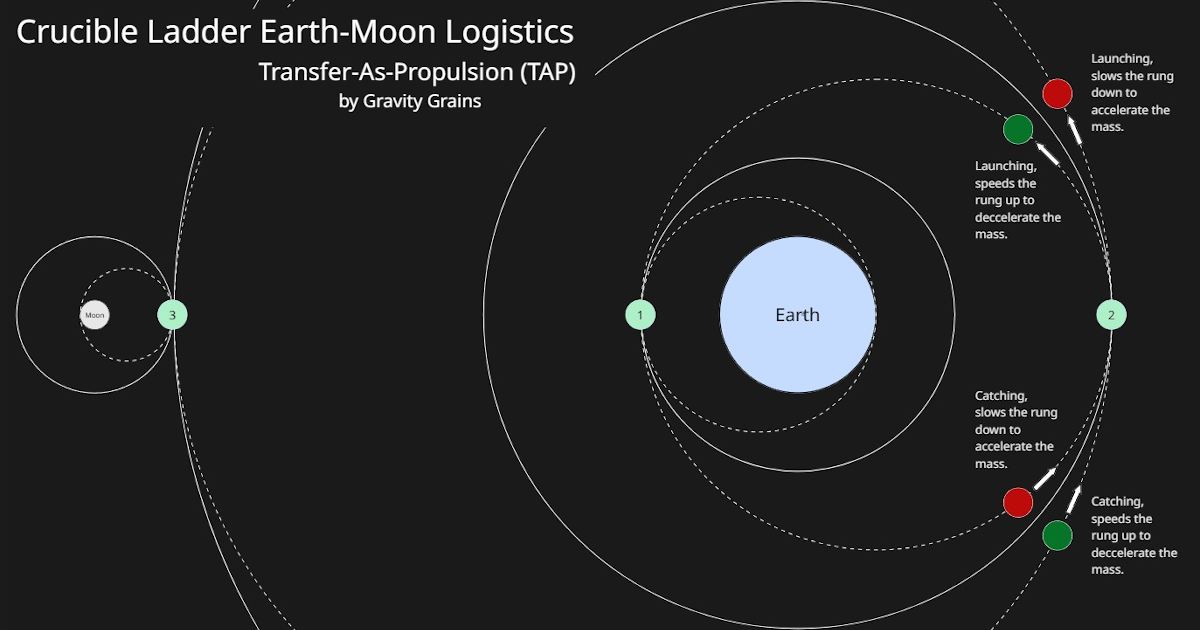
- Capturing a low‑energy intercept slows the rung. Launching into a lower‑energy delivery speeds the rung up.
- Capturing a high‑energy intercept speeds the rung up. Launching into a higher‑energy delivery slows the rung down.
As long as a rung remains bidirectional in its exchanges, it maintains its orbital altitude through balanced momentum flow.
Orbital Timing and Throughput
The orbital period of each rung introduces a coordination challenge. This is addressed by deploying multiple rungs at each orbital altitude and accepting a patient, cadence‑driven throughput model. Perturbations to each rung’s orbit, especially when operating across the Earth–Moon Lagrange region near L1, require a sophisticated logistics system to determine when and where transfers should occur.
Eleven equally distributed rungs by TAP value

Showing 0.4m/s rung spacing. Four of the eleven rungs are inside the Van Allen Belts. Higher rung spacing requires larger stations.
Mass Ratio and Station Stability
The mass ratio between a transfer capsule and its receiving rung is a functional constraint. Larger rungs experience smaller perturbations from each exchange, making it easier for them to reclaim altitude through solar sailing or to remain in a configuration that allows continued receipt and dispatch of transfers‑as‑propulsion. Smaller rungs require more careful orchestration to maintain position.
Physics, Orchestration, and the 4.0 km/s Dividend
By using transfers‑as‑propulsion, the Crucible Ladder distributes the energetic cost of moving payloads between Earth and Moon across simple physics and complex choreography. The journey is significantly longer than a direct translunar injection, but the reciprocity of momentum exchange effectively trades ~4.0 km/s between sender and receiver through the catch‑and‑launch mechanisms of each rung.
This removes roughly 4.0 km/s from the mission requirements of the payload itself, creating a “free” transfer‑as‑propulsion corridor between Earth and Moon.
Toward an Earth–Moon Transfer Economy
This ~4.0 km/s reduction opens a viable Earth–Moon logistics economy. Resources essential to lunar industry become deliverable to the Moon, and lunar‑derived outputs become deliverable to Earth. The only significant remaining propulsion requirement is the launch from Earth to LEO.
Each launch to LEO delivers another Caudex. Multiple Caudex form a new Crucible Ladder Rung. Multiple rungs improve the orchestration and throughput of the Ladder. As the system matures, it becomes stable and safe enough to exchange any equal‑mass payload between Earth and Moon, including crew.
Typical Payload Exchange
Earth to Moon: Carbon Sequestration, liquid nitrogen, liquid hydrogen
Moon to Earth: Lunar industrial outputs
Climbing Out of Excess Carbon
By making carbon sequestration a routine export, the Crucible Ladder converts a planetary‑scale burden into upward momentum. Each rung becomes a deliberate step away from Earth’s excess and a step toward a balanced Earth–Moon economy, where stewardship and industry rise together.